

Global Broker Regulation Inquiry App
About WikiFX
English
简体中文
繁體中文
English
Pусский
日本語
ภาษาไทย
Tiếng Việt
Bahasa Indonesia
Español
हिन्दी
Filippiiniläinen
Français
Deutsch
Português
Türkçe
한국어
العربية
اردو


Bitget Review 2026: Is this Forex Broker Legit or a Scam?

WikiFX
|


Abstract:Bitget represents a highly risky, unregulated platform with a deeply concerning WikiFX score of 2.16 and official regulatory warnings. Given the flood of severe withdrawal complaints and scam reports from real users, your funds are at a critical risk level with this broker.
Bitget Review 2026: Is this Forex Broker Legit or a Scam?
Executive Summary (TL;DR): Bitget is a highly risky, unregulated entity with an abysmal WikiFX score of 2.16 out of 10. Due to official regulatory warnings from top European authorities and a vast number of user complaints regarding blocked withdrawals and scams, we strongly advise traders to avoid depositing any funds here.
Before you find a Forex broker to entrust with your hard-earned capital, you must cut through the marketing noise and look at the cold, hard facts. Choosing the wrong platform can be a financially devastating mistake. In this comprehensive Bitget review, we will dissect the reality behind the platform to help you make an informed decision. Managing your expectations and recognizing red flags is paramount, which is why it is crucial to treat the WikiFX Score as a live data point. For Bitget, that score currently sits at a mere 2.16 out of 10. Let us delve into exactly why this rating is so low and what it means for your wallet.
Question 1: Bitget Regulation & Safety: Is my money safe?
When evaluating any financial service, the absolute most important factor to check is its regulation status. Unfortunately for Bitget, the safety check fails spectacularly. The company is completely unregulated, possessing zero valid licenses from recognized financial authorities.
Worse yet, their unauthorized activities have triggered official alarms. Both the Cyprus Securities and Exchange Commission (CySEC) and the Spanish National Securities Market Commission (CNMV) have issued formal blacklist warnings against Bitget, stating the platform has no permission to offer investment services.
Why does regulation matter so much? When you trade with a licensed, Tier-1 platform, they are legally bound to hold your money in “Segregated Accounts.” This means your funds are kept separate from the brokers operational money. With an unregulated broker like Bitget, you face massive “Counterparty Risk.” If the company goes bankrupt or the anonymous operators decide to shut down the servers, your money completely vanishes. You will have no legal protection and no financial compensation scheme to rescue you.
Question 3: What are real traders complaining about?
Rather than a few isolated issues, the WikiFX database reveals a systemic pattern of abuse, with at least 9 major complaints filed against Bitget recently. Real users from Indonesia, Argentina, Peru, Mexico, and Kuwait are all telling the exact same harrowing story: they are completely unable to pull their money out.
Victims consistently report being lured in by fake “advisors” (such as one using the alias Ricardo Torres Valles in Latin America) who promise massive returns on tiny initial investments. Once the trader's dashboard shows an artificial profit, the trap is sprung. When trying to withdraw, the broker demands huge, out-of-pocket payments—dubbed “taxes,” “account activation fees,” or “P2P release margins.” Moreover, Kuwaiti traders reported being lured through fraudulent WhatsApp groups in classic “pig butchering” scams. Other victims shared experiences of being redirected to highly convincing clone sites and phishing domains designed to steal deposits.
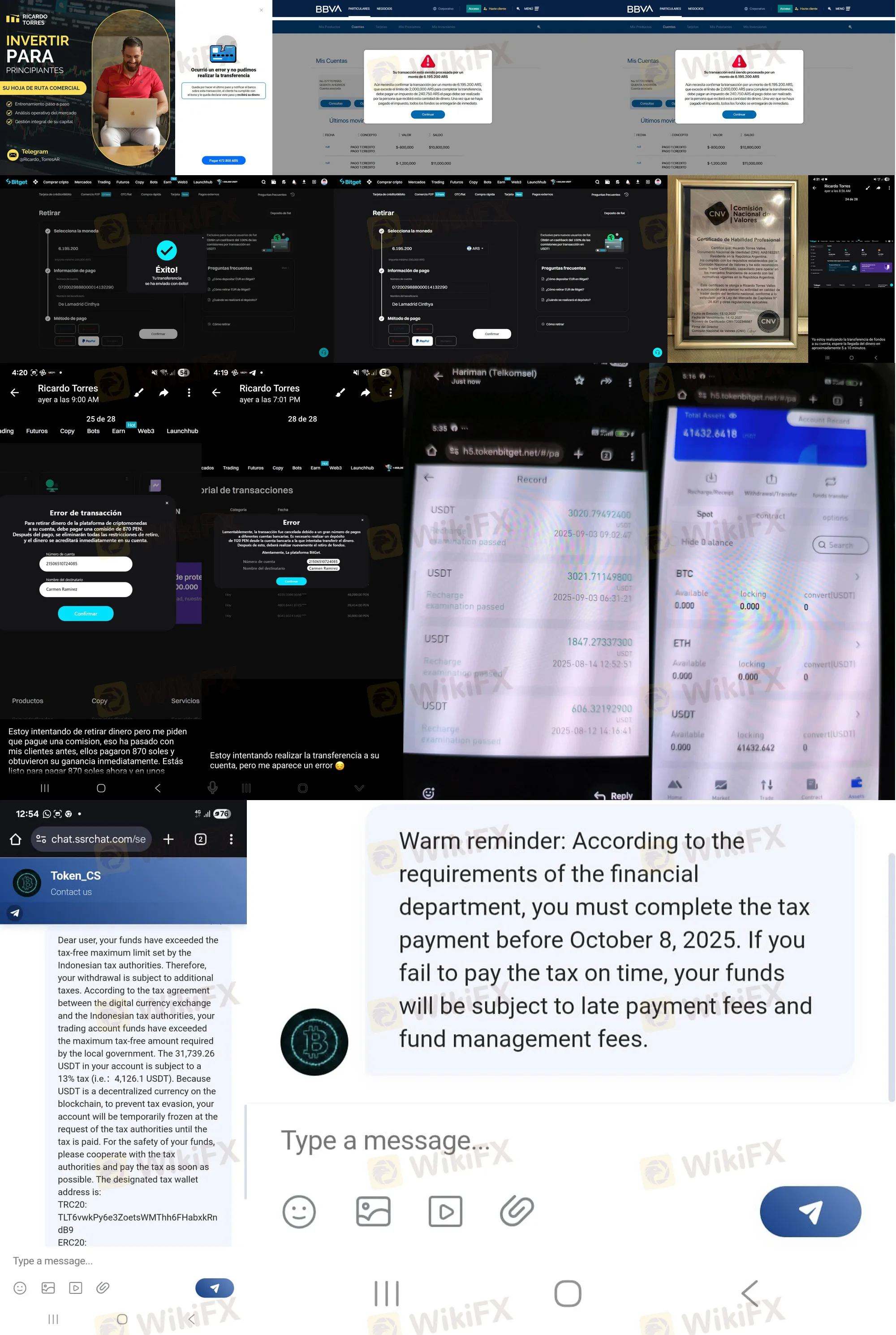
Pro Tip: A legitimate broker will never require you to deposit new, external funds just to cover taxes or fees for a withdrawal. Standard trading costs are always deducted automatically from your live account balance. The moment a platform demands a direct upfront payment before you can access your own money, it is a guaranteed scam.
Question 4: What software will I use?
According to the data, Bitget theoretically operates using the industry-standard MetaTrader 5 (MT5) platform. MT5 is highly favored globally for its deep analytical tools, customizable charts, and diverse language support.
However, good software does not make a safe broker. Because there are active reports of clone websites and malicious phishing applications targeting Bitget victims, you must proceed with extreme caution. Always ensure you are on the official site before entering your login details to avoid phishing scams. Furthermore, the verified WikiFX data indicates that their specific login setup lacks advanced safeguards like two-factor authentication (2FA) and biometric security, making your account highly vulnerable to unauthorized access.
As a crucial educational takeaway, remember that utilizing top-tier software like MT5 provides no safety if the broker controlling the back-end servers operates with malicious intent. Corrupt, unregulated platforms can easily manipulate price feeds or intentionally disable withdrawal functions on their server side, overriding any benefits the MT5 terminal offers.
Final Verdict: Should I open an account?
To put it directly: absolutely not. Bitget exhibits all the textbook characteristics of a systemic financial trap: zero proper regulation, official warnings from serious authorities like CySEC and CNMV, an abysmal WikiFX score of 2.16, and an overwhelming number of corroborated complaints from traders who have lost their money. Opening an account here exposes you to near-certain risk.
The financial industry's status changes daily, and scam brokers constantly rebrand. Before depositing into any platform, carefully check the WikiFX App for the latest real-time certificate, live regulatory updates, and user warnings to protect your capital.

Disclaimer:
The views in this article only represent the author's personal views, and do not constitute investment advice on this platform. This platform does not guarantee the accuracy, completeness and timeliness of the information in the article, and will not be liable for any loss caused by the use of or reliance on the information in the article.
WikiFX Broker
Latest News
Singapore tightens monetary policy in surprise move as rising oil prices rekindle inflation risk
WikiFXSPREDIX MARKETS Review: What Traders Should Know Before Depositing
WikiFXBXB Review – Zero Regulation, Dead Website: What Traders Need to Know
WikiFXHFM Review: No Regulatory Licences and a 1.83 Score , Is Your Deposit Safe?
WikiFXIs Your Withdrawal Plan Killing Your Compounding Gains?
WikiFXHFMARKETS TRADE Review: Zero Regulation and a Central Bank Warning
WikiFXWhy the Dollar Moves Almost Every Forex Pair
WikiFXChipmakers fall in US and Asia as AI jitters rattle investors
WikiFXBX Trade Review: Is This Unregulated Broker Worth the Risk?
WikiFXSTMARKET Review: Withdrawal Complaints Cloud a Low-Rated Broker, What to Know Before You Deposit
WikiFX